Wednesday, November 15, 2017

Constructed Space, 10/24/17 - 11/29/17, at Lemmerman Gallery, NJCU

by Megan Klim
11/15/17

What compels artists to painstakingly create alternate realities and spaces? At the exhibition Constructed Space, curated by Midori Yoshimoto, Ph. D., four artists specifically take on this quest with different approaches that are all fascinating and unique. With some of the work, the process is not immediately known, yet hints at something otherworldly, dreamlike and surreal, while other works lay it all out deliberately and concretely. Regardless, this exhibition forces us to pause and wonder about the spaces we create as humans, while addressing the desire to re-create and manipulate them.
Curt Ikens.jpg
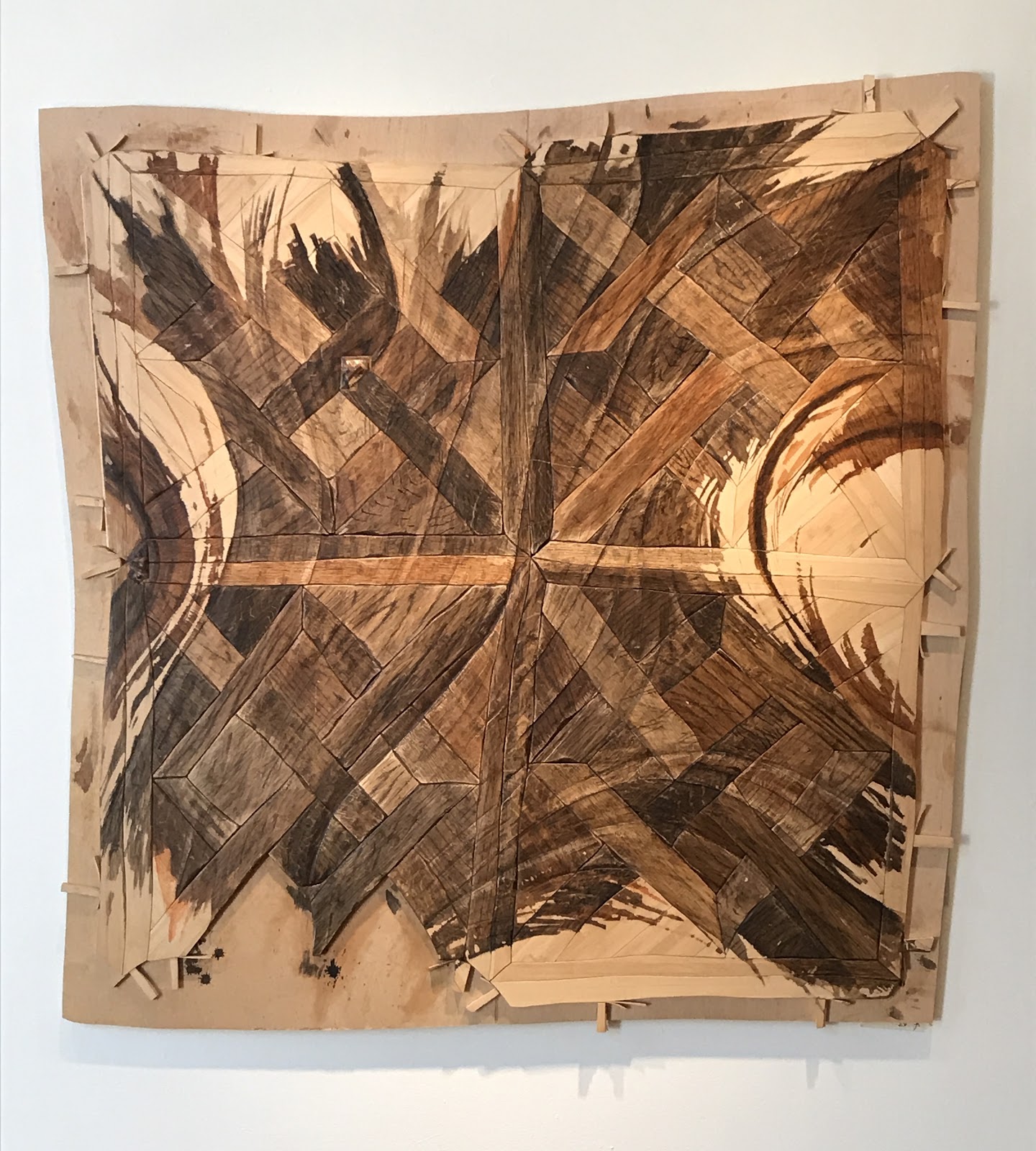
Curt Ikens  “Platform for a Skeptical Constituency”
IMG_1293 2.JPG
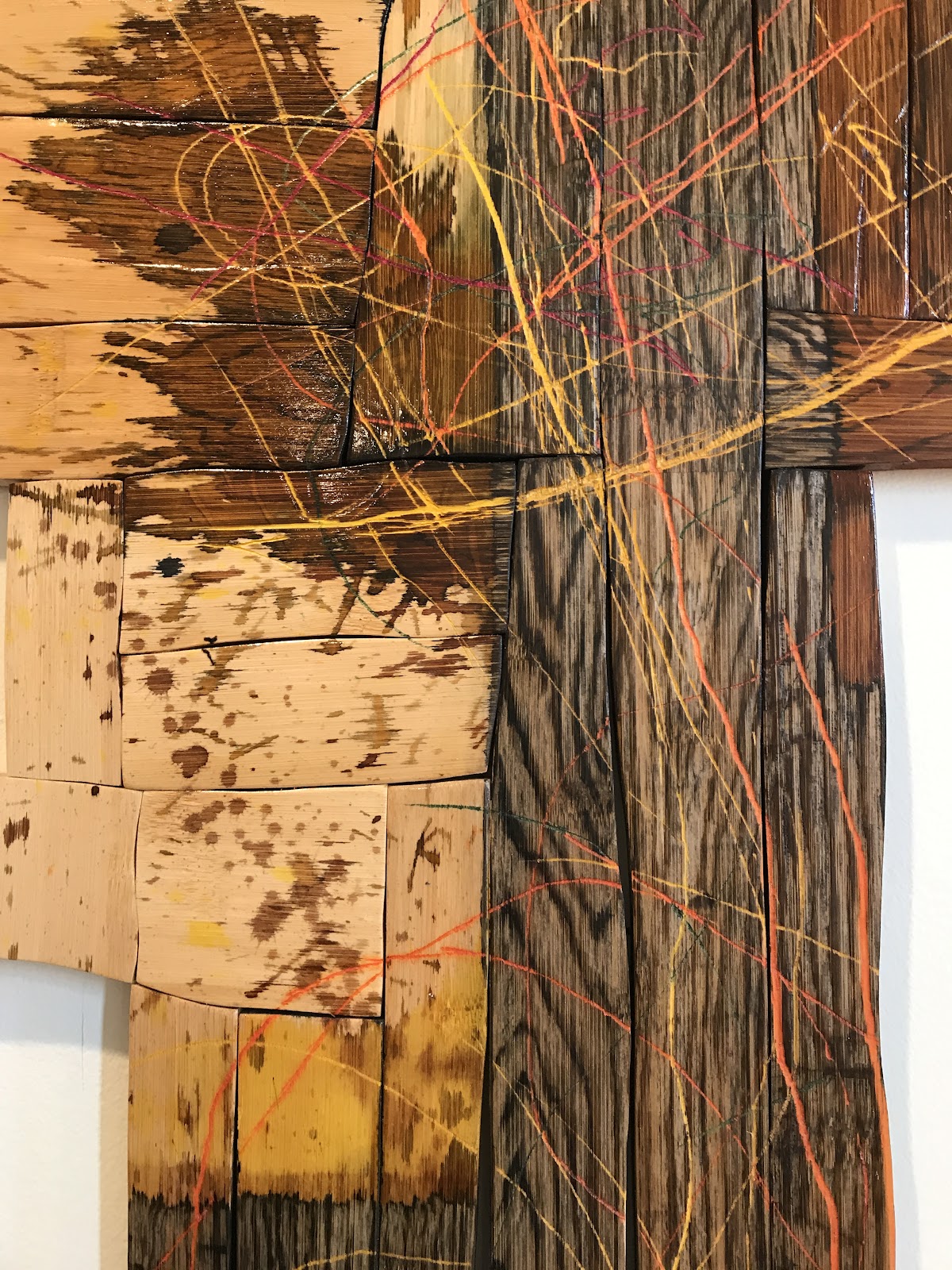
Curt Ikens, Detail of “Unpleasant Enough”

Curt Ikens’ work is one which invites the viewer into his process- all layers of it. One of the pieces “Platform for a Skeptical Constituency” is on the floor and built into the corner. The outer edges show the bottom plywood, then the unstained wooden planks on top, which slowly become fully stained and more organized and even contain some inlaid detail toward the corner. I really enjoyed this visual experience which isolates each component while also working as one piece. Another piece (pictured below) “Figments of Forefathers”, takes a big square of flooring and hangs it as an object. The organic shape reminded me of a wooden quilt. Instead of stitching, we see his hand with stain swipes, and an irregular joining of the wood. In other works, he has scratched in color which suggests a primitive scrawl that one would find when an errant child found a crayon. Ikens' relationship with wood is authentic and palpable- he honors the structure of the wood and is also compelled to dismantle it.

Kim Keever  “Blue Delta”

Kim Keever’s work is completely the opposite in approach. His dreamy landscapes and spaces make us wonder exactly where this place is- when in fact it exists nowhere other than here. There is a removed quality to the work– as if we are viewing it through a decidedly murky lens. Keever’s process is opaque and one would not guess it without explanation. These are not “real” landscapes at all; they are totally artificial detailed miniature scenes submerged in a 200-gallon water tank and then photographed. Even knowing this information, I struggled to see them as “unreal”. This work really provokes us into thinking about illusion, realities and actuality. In “Blue Delta” (below), we are taken down the “river” and through the “hills” while looking at a majestic glowing “sky”. Keever creates his own personal and ethereal world that has never existed until now, and by doing so, challenges us to think about landscape and its definition.


Martin Kruck "Cell"

Martin Kruck’s work plays with space. He juxtaposes an image with a location which, when viewed together, create an unexpected interior. Unlike Keever’s work, Kruck's locations do exist in reality- he reinvents and manipulates them into a whole new space. His art examines that initial space and alters it by adding in elements that play off each other resulting in a whole new perspective. In “Savoy”, he places a classical sculpture in a medical examining room for great apes. The grid tiled room is accentuated with the presence of the sculpture that stands over a cement slab. A twinkling dust-like material is in the atmosphere; giving this stark composition a hint of surreal magic. In “Cell” (pictured below), Kruck uses formal elements simply and effectively. The rough texture of the enclosed space envelopes the billowy cloud. The white geometric opening counters with the ethereal puff, while balancing the shadow at the bottom. Here we have heavy vs. light, and open, yet enclosed. Kruck plays with a space that on its own looks uninviting and grim, and then transforms it with the visiting cloud which simply hovers there as a hopeful intruder, bringing air and lightness to an otherwise claustrophobic, empty existence.

Jeremy Coleman Smith  “Cross Section:  Bottom Shelf”

Jeremy Coleman Smith’s work offers a domestic narrative. Smith recreates and elevates mundane scenes out of man-made materials, such as cardboard, paper and foam-core. These materials are usually of little value, but they ultimately assume the qualities of the original objects. By having all components fabricated in this manner, Smith invites the viewer to think about what these scenes or objects can mean, rather than what they are. The reality of the object is removed, stripped away, thus forcing us to ponder their significance or rather the significance we ourselves assign to them. In “Cross Section: Bottom Shelf”, Smith recreates a kitchen sink area. Upon close inspection, we see the sink is paper with the paper seams in viewa purposeful reveal of the hand-made. We also notice that he pays attention to detail by simulating the textures on the paper rubber glove and sponge in the sink. On the bare counter sits a wine bottle-shaped ceramic piece, and above that is, perhaps, a half-drunk glass of wine strategically perched on a window ledge. This is where it gets intriguing, as the artist leads us through the slightly obscured glass to a marsh-like, mysteriously lit landscape, which transports us out of the interior and into what lies beyond the mundane. 

Constructed Space, 10/24/17 - 11/29/17. The Harold B. Lemmerman Gallery, New Jersey City University, features work by Curt Ikens, Kim Keever, Martin Kruck and Jeremy Coleman Smith. The exhibit is curated by Midori Yoshimoto, Ph.D.

Monday, November 13, 2017

On a Different Page, 11/9/17 - 12/14/17, at Visual Arts Gallery, NJCU

by Megan Klim
11/12/17

The current exhibition on view at the Visual Arts Gallery reminds us that a book can be a cherished object not only for its story, information or message but as an intriguing piece of art that commands close inspection. Curator Eileen Ferara has smartly assembled a diverse group of artists that has interpreted the book by either altering them, paying homage to a classic, making a statement or re-imagining what possibilities a book can hold. 

Books are usually mass-produced; but artists' books are mostly one of a kind objects removing that aspect, therefore punctuating their individuality and uniqueness. I was curious to see this exhibition for a couple of reasons: I like the work of the artists chosen and am drawn to the idea of a book as a sculptural item. This exhibition is a well-rounded representation of the various ways a book can be viewed that also celebrates the book as object.  

Participating Artists in the exhibition are Aileen Basis, Kate Dodd, Asha Ganpat, Jaz Graf, Carole Kunstadt, Winifred McNeill, Ibou Ndoye and David Sandlin.

Read the rest of the review here.

Wednesday, October 18, 2017

A Rag, A Bone, A Hank of Hair, 9/6/17 - 10/18/17, at Harold B. Lemmerman Gallery, NJCU

by Samantha Garcia, Reporter
The Gothic Times, The Official Student Newspaper of New Jersey City University
10/16/17


Caroline Burton

On October 3, the Harold B. Lemmerman Gallery in Hepburn Hall held an artist reception for Caroline Burton’s A Rag, A Bone, A Hank of Hair.  The gallery was filled with curious students, professors and visitors, as well as familiar admirers of her work.  The gallery was lit with amber lighting, which combined with the light of the setting sun cast the works in a golden, glow—an almost magical atmosphere.

Read the rest of the article here. 

Wednesday, October 11, 2017

Sup-A-Genius: The Five Guy Show, 9/22/17 - 11/11/17, at Drawing Rooms

Harvest/Time
by Kate Dodd
10/11/17

All of the works in Sup-A-Genius, a show of five installations currently at Drawing rooms, deal with aspects of harvesting and time. The artists were all selected because of their tendency towards work that “works”, that labors and produces, as any good invention will. These are makers making something make something else, and as such, it is worth looking at both their process and their product.


Joe Chirchirillo

Joe Chirchirillo has been making heavy-duty sculpture for a long time. Here he puts his collection of implements to use to create a water cycle, aka a gravity-fed fountain that fills the room with a sort of creaky bucket brigade made up of old farm containers. In one corner, a separate mechanism spins sporadically, marked by a propeller wing labeled water on one side and wind on the other. Its laconic movement, along with the complex arrangement of the aged vessels, creates a sense of abandonment, as if the resources of wind and water have dwindled to a trickle, and all that’s left is the labor of this mechanism, determined to continue regardless of the existence of any resources, while the repeated sound cycle marks the ceaselessness of time passing.


Anthony Fisher
Anthony Fisher has drawings and a video showcasing his process, along with some of what might be his drawing tools, on display. The black and white drawings range in scale; all feature mysterious marks, some made up of several drawings that are inlaid into each other. Delicate lines wrap around themselves on a ground that looks tough, grey, pocked by grit. This toughness connects to the brutish tools nearby, made up of weights and wheels on brooms. The video of Fisher arduously pushing heavy implements over paper on his studio floor supplies the link that reveals his process. Jackson Pollock meets Chris Burden. One could consider these drawings machine-made, albeit with significant labor on the manufacturer’s part, with the traces of the tools’ movement as the product being created; Fisher then “harvests” the raw material he has cultivated and fashions it into drawings and collages, elegant records of sheer willpower.


Roger Sayre

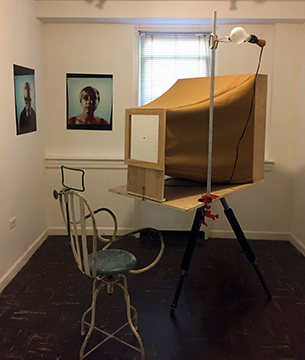
Roger Sayre actually uses his room as his portrait photography studio, complete with a refurbished clinical chair for clients and a large pinhole camera. The challenge here is to sit still enough, long enough, while staring at oneself in a mirror Sayre has rigged up, to result in a fixed image. A conflated Warhol Screen Test of sorts. Portraits done in this manner line the walls, in both black and white and color, each seeming to reveal its subject as if through a long journey from a distant place. The color portraits, in particular, refer to the myth of Narcissus, with the liquid-y backdrop suggesting that we’re actually peering through water at the subject floating beyond us, a reflection but not the real thing. These are the opposite of selfies; they require an attempt at introspection on the part of the subject rather than the masked pose marking one’s non-present presence at places or events of note. Sayre is distilling the essence of time spent with a disciplined will.


Kurt Steger

Kurt Steger’s work asks participants to give freely and endlessly of their time as well, although one would not know it by looking. His drawings of perfect circles in rich earthy hues on immaculate white paper make one think of a highly singular force.  The controlled drops of toxic water that create these rings contradict the purity of form, but don’t reveal the communal process required to manage such exactness. To create these, Steger asks participants to tend to the melting drips at the end of a swinging plumb line by rotating the paper surface that they land on; he hopes to create a communal experience reminiscent of tending a fire while sharing stories and wisdom. He has set up a contraption to illustrate this, although its diorama-like scale leaves it functionless, making the connection between the vagaries of people’s informal communal abilities and the refinement of Steger’s circles hard to reconcile.


John Morton

Fittingly, John Morton’s audio installation challenges us to not only participate in this harvesting of human will, but to believe in it as an action that will yield results. Belief is the subject of Fever Songs, a series of recordings of spiritual ecstasy from cultures around the world. As with other proximity sensor-driven pieces, this one requires experimentation and patience. Without enough movement around the room, aka participation on the part of the viewer, the sounds retreat to silence, possibly beckoning you back only as you walk out the door. The absence of voices prompts one to try again, to actually have faith that one’s presence is the thing that initiates action, a clear parallel to engagement with spiritual practice. The sensor acts as a god, reflecting back whatever one is willing to invest.

Each “Sup-A Genius” invention in this show suggests that a process will produce a product. Whether Sisyphean or hopeful, all of these works evoke a sense of effort, of sheer will, of “I will make this happen despite all odds” adding up to a mood of eloquent desperation in a world where effort doesn’t necessarily determine the outcome.

Sup-A-Genius: The Five Guy Show, 9/22/17 - 11/11/17, at Drawing Rooms, features works by Joe Chirchirillo, Anthony Fisher, Roger Sayre, Kurt Steger and John Morton. The exhibit is curated by Anne Trauben.

Kate Dodd is an artist and an art teacher in public and private schools for 25 years. Read Kate's bio here and view her artwork here.

Saturday, October 7, 2017

Honoring Margaret: The Work of Margaret Weber, 9/22/17 - 11/11/17, at Drawing Rooms

by Midori Yoshimoto, Ph.D.
10/6/17


The birds are embodiments of the threatened world of nature and a spiritual aspect or projection of humans, an alter ego, in a sense: knowing and vulnerable.
                                                                       - Margaret Weber


Dark Passage #1, 18” x 18”
Intaglio ink, Caran d’Ache neocolor crayon on paper.

In the over thirty works by Margaret Weber which are on view at the Drawing Rooms, certain over-arching themes emerge. Nature, as well as man’s interaction with it, and concerns over environmental and human destruction predominate. In the first room, a hawk is hailed as a harbinger, carrying a small human skull on a stem over what appears to be a deluge. According to the artist’s statement, this series of intaglio prints from 2013, entitled, Dark Passage, asks a question: “Will nature carry on despite human destruction?” The question is even more poignant now that politicians and corporations do not even acknowledge the effects of global warming and the fact that it is largely caused by human destruction and pollutions. Weber titled her 2013 catalog, published by Victory Hall Press, “Birds of Pray,” turning the usual predatory birds—hawks, falcons, owls— into prophetic seers of human destruction, while still holding out a hope for some force behind man, a divine force, delivering us from ourselves.


Birdcage

Birds are part of several recurring motifs throughout this modest, yet thought-provoking retrospective exhibition - dedicated to Weber, who unfortunately passed away last year due to cancer. Since Weber moved to Jersey City from New York City in the early 1970s, she completed both undergraduate and graduate studies in Fine Art at the Jersey City State College (now New Jersey City University), and taught art at Jersey City’s public schools for nearly three decades. Because of her devotion to art education and art advocacy for the emerging artists’ community in Jersey City (including co-founding of Drawing Rooms), she is honored by this posthumous exhibition.   


The Flea and The Mortal
Painting, Collage, and Intaglio, 2007

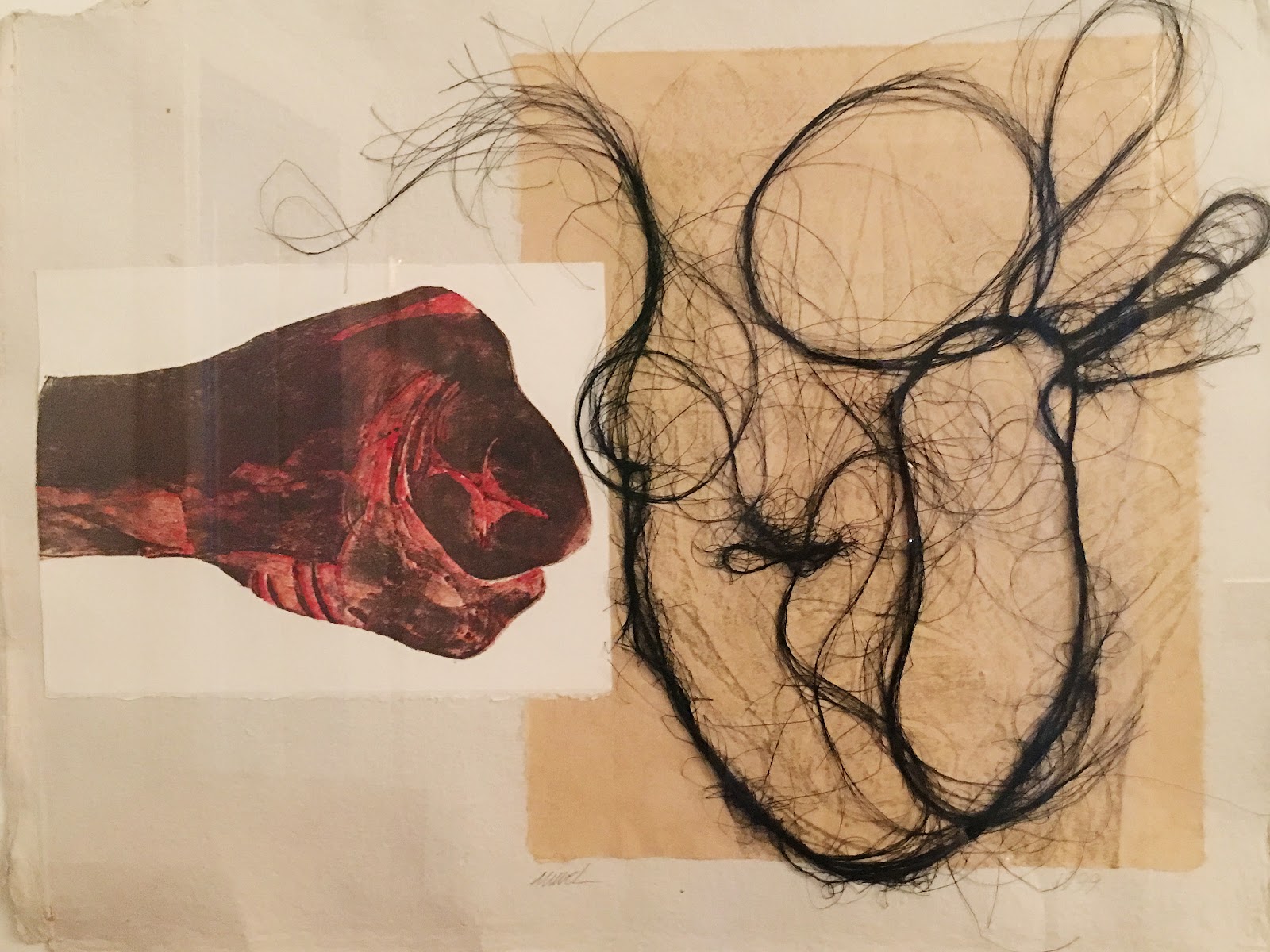
Weber repeated her favored motifs, of birds, birdcages, helicopters, and various body parts because she ran an intaglio studio and was able to utilize the same intaglio plates to create multiple impressions. She would often cut out her prints and collage them with found paper, textile, feathers, and other materials. In one of the largest works in the exhibition, a diptych entitled, Song of Icarus, helicopters emerge out of the body of a goddess-like figure who has actual bird feathers for hair, while a large hawk covered with human hair is falling into the ocean as Icarus did in the Greek myth. By exchanging some of human characteristics with those of a bird, Weber sought to evoke both the “bond and rupture” between human and animal nature. (Weber, p. 46). By creating a warm tonality of bright colors in this diptych, however, she embedded elements of hope in an otherwise fatalistic scene.


 Double Feathered Eye

Weber’s interest in Greek myths and her ability to connect them to contemporary social and political concerns recalls Nancy Spero and her drawings/collages. Like Spero, some of Weber’s work centered on the symbolism of female bodies, visualized as fragmented body parts. Mixing personal and political concerns echoed the strategy of the feminist art movement as well. A couple of her works also contain the motif of fists, expressing the power to resist and fight. An exhibition like this will hopefully inspire younger audiences who are distraught in the current political climate to find their own voices and the means by which to express them.


2017-09-23 02.41.16 1.jpg
Red Fist

Reference: Margaret Weber, Birds of Pray (Jersey City: Victory Hall Press, 2016).


Honoring Margaret: The Work of Margaret Weber, 9/22/17 - 11/11/17, features drawing, collage and prints by Margaret Weber. The exhibit is curated by Anne Trauben.

Midori Yoshimoto is Gallery Director and Associate Professor of Art History at New Jersey City University. Read more about Midori here.

Wednesday, August 30, 2017