Showing posts with label Photography. Show all posts

Wednesday, November 8, 2023

Lucy Rovetto: For the Love of the Body at The Alcove Gallery at Drawing Rooms, 9/29/23 - 11/11/23

Lucy Rovetto’s Career-Long Exploration on the Human Anatomy’s Response to Emotional Stimuli at Drawing Room's Alcove Gallery
By: Lumane Luma
11/7/23


On view at Drawing Rooms Alcove gallery, Exhibitions Director Anne Trauben curates the career-survey "Lucy Rovetto: For the Love of the Body" with works spanning from 1989 - 2022. The separations of decades within the exhibition displays Rovetto’s psychological response to the zeitgeist. Years 1989 and 1990 feature photographs of intimate encounters with the body with compositions that show the beauty of its form. From 1994 - 1996 Rovetto’s sophisticated artistic exploration began to formulate. 

Cross-Eyed by Lucy Rovetto

In her 1994 “Cross-Eyed,” small photographs of repeated images of the nude artist laid forward are collaged in a sequence of rows. The image likeness appears as a coronary examination while the composition’s top center of the overexposed photographs are juxtaposed to appear as procedure lights seen above a patient before drifting to unconsciousness.
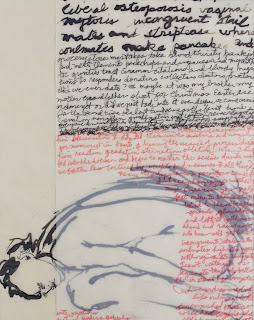

Squeeze with Words by Lucy Rovetto

In the 2010s, Rovetto’s medium focus on drawings evoked the encroaching claustrophobia of anxiety. 2014’s “Squeeze” and “Squeeze with Words'' appears as a progression of intrusive thoughts as both works are a rendition of a figure in a fetal position, though “Squeeze with Words'' is juxtaposed with illegible writing decreasing in scale to whispers as the ink goes from black to red. Also from 2014, “Facing Myself Right” is a large ink on wood outlined profile portrait of the artist that conveys Rovetto’s self-examination stripped to subtle details, a humbling confrontation of oneself to question what is the basis of identity.

Bound by Lucy Rovetto

For the new decade, Rovetto deters from a state of introspection, instead provoking the viewer with an unsettling scenario in "Bound", "Captured," and "Moth" which depict different perspective shots of an unidentified femme figure held restraint. The figure is sat in a chair, mouth bound with hands tied behind their backs. The viewer is a helpless observer behind the serrated screen of the grim scene. Drawn in comparison is the helplessness of observing through our devices, the chaos amidst the Covid-19 outbreak and socio-political upheaval in 2020.

Rovetto then symbolically details the gravity of emotions on the body with “Hanging Series.” Suspended from wire hangers, the works on paper appear like a play on the expression, “Hang to Dry,” which is likened to the feeling of being left to suffer alone. Of the three “Hanger Series,” Girls Got Guts (see postcard image above) is most intriguing, as it is a paper collage diagram of the viscera. It functions as an emotional signifier of our internal truth.

The dedication Rovetto has for exploring the human form has opened her horizon to utilize various forms of medium seamlessly. Each method serves its purpose for conceptual exploration from documentation in photography, psychological inspection with drawings and writing, to replicating visceral stimuli with textural 3-D materials. Rovetto’s works attune the presence of the body. The viewer is assigned the role as a test subject on nonverbal transmission. This is the basis of humanity.

"Lucy Rovetto: For the Love of the Body" will continue on view at the Drawing Rooms Alcove Gallery until November 11, 2023.

Lumane Luma is a curator and the founder of Luma Art Advisory. Learn more about Luma here.

Saturday, July 1, 2023

NJ & Me: Imperfect Together, 5/25/23 - 7/29/23 at The Terrarium Gallery and The Alcove Gallery at Drawing Rooms

Imperfect Impressions: NJ and Me…
by Peter Delman
6/26/23


In the climactic final scene of Steven Spielberg’s semi-autobiographical film The Fabelmans, the young aspiring filmmaker meets the cranky legend John Ford. Ford (played by David Lynch, of course) has only patience enough to share one piece of wisdom with the neophyte: “The horizon at the bottom of the frame is interesting. The horizon at the top of the frame is interesting. The horizon in the center is boring as shit!”

The artists in NJ and Me: Imperfect Together embrace this lesson, no doubt without coaching from a cantankerous maestro. There’s hardly a middling horizon in sight, and glorious skies and evocative foregrounds are the result. Tim Daly’s low horizons and big skies give his luminous clouds room to roam. In Tim Heins’ Dusk, Jersey City, bands of enigmatic color blaze like chevrons across a banner of sky.

In movies the high angle (horizon at the top) is used to express vulnerability. In Dorie Dahlberg’s stark beach scenes, Love Before COVID 2 and New Year’s Day. Will This Be the Year?, a few isolated figures brave the cold winter winds in a vast expanse of sand. In contrast, the sun shines bright in the beach paintings by John Meehan III and Sue Ellen Ley. In Meehan’s Safari Towel the looming Dad silhouette balanced by the crouching figure in shadow gives the painting an extra jolt of Baroque energy.

Lots of attention is paid here to New Jersey’s urban scene, though just about everyone wisely gives contemporary architecture a wide berth. Alan Ostrowski’s loving drawings of the Bayonne bridge sparkle. Kevin McCaffrey’s Hoodsin County is an understated send-up of historical maps. You need to pay close attention to catch all the playful humor in this and his other works. McCaffrey cites Finnegan’s Wake as a major influence on his process. His lodestar is Joycean stream of consciousness, and these images deliver unpredictable surprise—even to him. The plot thickens when he discusses his former life as a Dominican priest, and there’s the flawless rendering of the map itself, which even divine inspiration can’t account for.

Anne Trauben’s portraits of Jersey diners capture the full brilliance of their iconic neon signs. (Kudos to Trauben for curating this ambitious, intelligent exhibition.) Christopher Z. is also intrigued by signs, which flow across his drawings with the grace of water. James Pustorino’s Wildwood photographs celebrate the engineering of some of our most gonzo, loopy creative minds. It’s a pleasure to see this gem of pop culture still preserved and being enjoyed to the hilt.

In Photo Sculptura 2, Jean-Paul Picard uses a glass brick wall as a ready-made distortion filter. There are echoes of art history evident here—cubist fragmentation, surreal mystery, the grid. But in the end, thanks to the instant karma of the camera shutter, the image is an up-to-the- 
minute shining artifact of the present.

“Sign on the window says lonely” is my favorite opening lyric by Bob Dylan—an apt tag line for New Jersey, to judge by much of the work in this show. The few figures on Dahlberg’s beaches punctuate their bleak emptiness. Tim Daly’s highways are more deserted than in the first week of COVID lockdown. No one ventures out onto the spooky dollhouse streetscapes of Jessica Rohrer’s Precisionist paintings. Rohrer describes these immaculate streetscapes as “sanitized” and “disturbing,” and agrees that The Rapture might conceivably begin on her block. They are based on drone stills, which may have something to do with why they bring to mind films like Blue Velvet and The Truman Show.

Lauren H. Adams goes right for the heart of desolation. Her discarded couches are a lesson in how mute objects are capable of speaking to us with achingly poignant eloquence.

I went to college in Vermont. My freshman-year student dorm counselor was from Oklahoma. He was very impressed with lush Vermont, but took great delight in mocking New Jersey as “the armpit of the nation.” I didn’t know then that much of the Garden State is just as green as the Green Mountain State. As for Oklahoma, it’s presumably OK.

Forty percent of New Jersey is forested, and several artists here speak for the trees.  Doug Madill’s painting of Leonard Gordon Park captures, with expressively assured brush strokes, the golden light of a summer evening on urban trees. Edward Fausty’s exquisite photographs of woodlands are a moving testament to what we have and what we stand to lose—elegiac 
reliquaries for precious fragments of the true world. He describes his spherical images as evoking the experience astronauts have viewing the earth—"a living rock floating in the black void.”  Fausty knows what it is “to see the world in a grain of sand.” 

Viewing Eileen Ferara’s painting of the Hudson estuary, we imagine for a moment that the turbulent, unruly forces of nature have the power to hold at bay the “dark Satanic Mills” lurking in the background. I see Anne Percoco’s gentle installation Heap II as a riddle or koan: “when is a leaf not a leaf?” Is the pile of leaves, meticulously fashioned from paper street litter, a reproach, or something more ambivalent? So it goes in our imperfect New Jersey state of mind.

NJ & Me: Imperfect Together is curated by Anne Trauben.

Peter Delman is an artist living in Jersey City. Read Peter's bio here and view his artwork here.

Learn more about the exhibition and view images on Drawing Rooms website here.

Friday, January 31, 2020

THE BIG SHOW: All Animals Welcome, 12/14/19 - 2/8/20, at Drawing Rooms

by Bruce Halpin
1/29/20


THE BIG SHOW: All Animals Welcome at Drawing Rooms is a big (nearly 70 artists, 136 works) rambunctious offering. Curated by Anne Trauben, the works include paintings, prints, drawings, photographs, video and objects. The works in the show investigate the varied relationships humans have with animals as companions, providers of utility as well as objects of reflection and metaphor.

“Midnight Companion” by Judith Witlin


“Secret Conversation” by Judith Witlin


“Goddamn Crow” by Michael Lavorgna


“Moonlight Deer” by Michael Lavorgna 

“Anecdote of a Chiken” by Ibou Ndoye

“House Mouse” by Ibou Ndoye

The earliest figurative paintings were of animals. Their function is largely open to conjecture but seems to revolve around the hunt and suggest a spiritual connection between the animals and the hunters. This is certainly the case with paintings by the Indigenous Peoples of North America. Many works in the show convey a spiritual connection to their subjects. Among these are the monoprints “Midnight Companion” and “Secret Conversation” by Judith Witlin. Two works by Michael Lavorgna “Goddamn Crow” and “Moonlight Deer” share that dreamlike quality. Two small works by Ibou Ndoye “House Mouse” and “Anecdote of a Chiken” also suggest a shamanistic connection between artist and subject.

“Double Rainbow” by Bud McNicol

“Breakfast Surprise” by Robert Zurer 


“Flamingo” by Eileen Ferara 

Anne Trauben’s video “Indie’s Escape”


Alejandro Ruben’s video “Earthworms”

A sense of humor is a strong current which runs through the show. Bud McNicol’s “Double Rainbow” presents a camping trip gone terribly awry, it’s hilarity underscored by it’s anodyne title. Robert Zurer’s tiny painting, “Breakfast Surprise” is a goofy, yet beautifully painted, rendering of what appears to be a giraffe wearing a red surgical mask. Eileen Ferara’s “Flamingo” is reminiscent of a painting by Audubon on acid with its woefully convoluted neck. Anne Trauben’s short video “Indie’s Escape” displays a rather madcap humor (I won’t spoil it by describing it). Likewise, Alejandro Ruben’s “Earthworms” is dryly humorous, contrasting the video of the worms with a Salsa soundtrack.

"Let Sleeping Dogs Lie" by Andrea Geller


"Shadow" by Andrea Geller


"Waiting" by Andrea Geller


"Waiting II" by Andrea Geller


Tracey Kerdman’s painting “Milk Teeth”


Tracey Kerdman’s painting “The Offering”

While animals as companions comprise a substantial portion of the works here, a number of pieces exceed the documentary. Andrea Geller’s four oil paintings are really meditations on the nature of materials, color and light. These paintings are forcefully beautiful with deft handling of paint. Similarly, Tracey Kerdman’s paintings, “Milk Teeth” and “The Offering” transcend their subjects in weird, uncomfortable ways. “Milk Teeth” shows two adolescent boys flanking a German Shepard. The undercurrent of unease is not in what this painting shows, but, rather, in what is left out. “The Offering” evinces a similar displacement of normal life. The subject (a dog) is presented as a specimen or object of examination, clinically displayed as if in preparation for some sort of procedure. In both of these works there is an inversion of the “family pet” picture, with an unstated but felt menace lurking somewhere beyond the frame.

"Pelt 4" by Caroline Burton


"Pelt 5" by Caroline Burton

"Pelt 6" by Caroline Burton

"As Luck Would Have It" by Caroline Burton

Caroline Burton’s paintings “Pelt”, “Pelt”, “Pelt” and “As Luck Would Have It”, draw attention to the idea that our relationship to the world of animals is not always benign. Her sensitively painted pelts belie the violence, which transforms them from the skin of a living animal to an object, presumably of utility. Perhaps Ms. Burton’s intent is to disrupt the sentimentality inherent in “cute furry things”, injecting a dose of reality for our consideration.

"Keeping Us in Line" by Stephen Krasner

Many of the works I can only mention in passing but deserve appreciation. They occupy a category I can only describe as “other”. Steven Krasner’s sensitive portraits of his poodle companion have a glow that seems almost otherworldly and thoroughly transcend the “pet portrait”.

Cheryl Hochberg’s “Wool Spinner”

Robert Levy’s “Loading Zone”


Joshua Field’s “Thinking About the Many Ways We Are Bound”

Works that consider the utility of animals include Cheryl Hochberg’s “Wool Spinner”, Robert Levy’s “Loading Zone” and Joshua Field’s “Thinking About the Many Ways We Are Bound”. Mr. Field’s work seems to be based on a manual of how a horse is hobbled but expands to become metaphor.

"Wandering Cow" by Beatrice Mady

"Second Life of Limulus Polyphemus" by Milosz Koziej

"Beavers Revenge" by Casey McGarr

"Curly Rabbit" by Casey McGarr

"Squirrel Revenge" by Casey McGarr 

"Kafka's Pet" by Emily Broussard

"Long Elephant" by Cheryl Gross

"Polar Bear" by Cheryl Gross

"Small Giraffe" by Cheryl Gross

Eugenio Espinosa, "Tere con Repisa"

Eugenio Espinosa, "Abuelo, Marti, Papis"

Eugenio Espinosa, "Venados, Loma"

Lizzie Scott, "Mantaray"

Lizzie Scott, "Mantaray"


Brad Terhune's "Psychedelic Goats and Other Horned Creatures No. 2"


Brad_Terhune's "Psychedelic Goats and Other Horned Creatures No. 3"


Brad Terhune's "Psychedelic Goats and Other Horned Creatures No. 4"


Jodie Fink's "Avemhamo"


Jodie Fink's "Equusavem"

Works that defy categorization but deserve consideration are Beatrice Mady’s “Wandering Cow”, Milosz Koziej’s “Second Life of Emulous Polyphemus”, Casey McGarr’s broadly comic letterpress works, Emily Broussard’s deft painting of a roach, Cheryl Gross’s mixed media work, Eugenio Espinosa’s porcelain works, Lizzy Scott’s “Mantaray”, Brad Terhune’s pop inspired collages, and Jody Fink’s found object creatures which are just plain fun.

There are many more funny, profound, perplexing and well executed than those mentioned above, more than time permits. Anyone interested in animals, contemporary art, or are just in need of an uplift should go see the show in person. It’s well worth the trip. And bring your pet.

THE BIG SHOW: All Animals Welcome, featuring works by artists Alpana Mittal, Adriana Robertson, Alan Walker, Alejandro Rubin, Allen Strombosky, Andra Samelson, Andrea Geller, Anne Q McKeown, Anne Trauben, Beatrice M Mady, Bill Stamos, Brad Terhune, Bruno Nadalin, Bud McNichol, Caridad Kennedy, Carmen Recio, Caroline Burton, Casey McGarr, Cheryl Gross, Cheryl Hochberg, Chris Garcia, Eileen Ferara, Emily Broussard, Eugenio Espinosa, Gloria Adams, HJ Kleiber, Ibou Ndoye, Jane Dell, Jane Westrick, Jane Zweibel, Jodie Fink, Joe Lugara, Joshua Field, Joy Bush, Judith Witlin, Katharina Litchman, Katie Niewodowski, Kevin McCaffrey, Kim Wiseman, Laura Lou Levy, Laura Pawson, Linda Byrne, Linda Gottesfeld, Lizzie Scott, Lola Sandino Stanton, Lori Field, Lydia Viscardi, Lyubava Kroll, Marcia G. Yerman, Mary Beth King, Michael Lavorgna, Milosz Koziej, Mollie Thonneson, Nanette Reynolds Beachner, Pam Marchin, Rachel Aisenson, Rebecca Major, Robert Levy, Robert Zurer, Ry An, Sarah Walko, Scot Wittman, Stephen Krasner, Steven Barker, Tracy Kerdman, Vija Doks, Zewen Wang, continues until February 8 at Drawing Rooms at 926 Newark Avenue in Jersey City. A selection of works from the show can be viewed online at the Drawing Rooms website.

THE BIG SHOW: All Animals Welcome at Drawing Rooms, 12/14/19 - 2/8/20, is curated by Anne Trauben.

Bruce Halpin is an artist living in Jersey City. Read Bruce's bio here and view his artwork here.