by Lindy Judge
2/1/18
2/1/18

Some things do improve with age, and THE BIG SMALL SHOW 2017 at Jersey City’s Drawing Rooms is one of them. Currently, in its fifth year, The Big Small Show 2017 brings together a large array of exceptional recent works by over 100 artists in the intimate setting of a former convent. This show is always worth seeing, but this year the works and the curation are unparalleled.
With 100+ artists contributing 2 to 4 works each, there is a
lot to see, and one might expect it to be overwhelming. However, due to the
expert curation of Anne Trauben, the experience is anything but. In fact, it is
fun, thought-provoking, and thoroughly enjoyable.
The full range of media is represented—painting, drawing,
sculpture, photography, mixed media—all thoughtfully arranged in 8 rooms, the
gallery shop and the hallway. As a framework, each room has a curatorial theme:
Images and Objects; Landscape; Ethereal and Elemental; Memory; Surface—Subtle
and Complex; People and Places; Drawing; and Bold and Big. I see these as
suggestive rather than summative. I didn’t read the room titles on my first
viewing. Instead, I looked at the works individually and then considered the overall
impression of the grouping. On a subsequent viewing, I made a point of reading
the titles and descriptions, which added another level of appreciation of the
works and the themes being explored.
In broad strokes, the themes reflected in a show of this
size naturally include many of the issues confronting us all: the environment;
the politics of culture, sexuality, and gender; relationships; communication;
etc., as well as the issues that specifically concern artists in their work:
aesthetics, form, purpose. Individual artists address these issues in work that
is literal or abstract, theoretical or personal, and through explorations of
presentation, process, and materials. The one condition imposed was that the works
could be no larger than 30 inches, and the smaller-scale benefits the overall
experience; it requires viewers to step in a little closer to get a good look.
It is impossible to talk about each and every piece—although
they are all worthy of discussion—so I will highlight some that come to mind.
When viewing a piece of art, we tend to contextualize the
work by our reaction to the form or content, or by what it seems to convey. We
don’t generally think about the process, although process is an essential part
of the communication between artist and viewer. Several pieces in this show succeed
in prompting the viewer to pause and consider the process, for example: Roger
Sayre’s photographs, Maureen McQuillan’s hypnotic ink and acrylic pieces, Bruce
Halpin’s inexplicably flat colors, and Michael Kukla’s “Star 1”.

Michael Kukla, “Star 1”
(2015, marble)
(2015, marble)
Kukla’s small marble sculpture initially draws
you in because of its beauty and mystery. Although literally “set in stone”, it
reveals a realm that isn’t limited by time or space, and also leaves you in awe
of the process, asking out loud, “How did he do that?”
Among the “Memory” works are the photographs of Roger Sayre,
such as “Deirdre 2”,

Roger Sayre, “Deirdre 2”
(2017, C Print)
whose subtle erosions of form have a ghost-like quality. These
mysterious, indefinite images challenge our perception of identity, perhaps urging
us to wonder if something ceases to exist because our “image” of it has been seriously
altered. Sayre might posit that a crystal clear image doesn’t represent a
person at all. His subjects sit for an hour-long exposure. Since it is
impossible to hold any single expression for that long, all expressions merge
into one image, and thus the subject’s “essence” is revealed.
Although not officially part of this grouping, Josef
Zutelgte’s work also investigates memory and identity. His sculpture “Mutter" (German for "mother")

Josef Zutelgte, “Mutter”
(2016, paper, aqua resin)
deals with dementia, and through the use of negative space
explores the notion of being “there and not there.”
Ilene Sunshine’s strange and seductive sculptures are indeed
“Ethereal and Elemental.” Pictured here is “A.M. #7”.

Ilene Sunshine, “A.M. #7”
(2016, handmade abaca paper over salvaged plastic,
acrylic paint)
(2016, handmade abaca paper over salvaged plastic,
acrylic paint)
The curious and dreamlike quality of her objects also brought
back memories of semi-opaque pieces of sea glass found along a shore and all
the imagined histories adhered to them.
The repurposing of salvaged objects and materials is a
recurring aspect of many of the works, as are the subjects of nature and human
interaction with (and impact on) the environment. Maggie Ens’s multi-media
works incorporate discarded, manmade objects along with more organic items to
create “nature” scenes that challenge reality. Ens adapts the tradition of
Still Life. She builds 3D canvasses and employs unconventional constructions,
resulting in a tension that is both surprising and satisfying.

Maggie
Ens, “The Old Soft Shoe”
(2015, mixed media)
(2015, mixed media)
Jeanne Heifetz’s “Mottanai” series contemplates preservation and the push to recycle, reuse and repurpose. Mottainai is a Japanese term warning against waste.

Jeanne Heifetz, Mottainai 13,
(2016 ink on gampi torinoko paper hand-dyed with indigo)
(2016 ink on gampi torinoko paper hand-dyed with indigo)
Other traditional genres that are reimagined in this
exhibition are Landscape and Portraiture. Jennifer Krause Chapeau’s rich, moody
oil paintings depict landscapes as they are most typically viewed today—in
motion, from a commuter’s car or a train.

Jennifer
Krause Chapeau, “Eolienne II”
(2017, oil on canvas)
(2017, oil on canvas)
A sweet surprise is the charming and sincere portraits by
Rajendra Mehta, which the artist notes were painted with a knife. Patricia
Fabricant’s deconstructed and decomposed self-portraits, such as “Faceless” investigate
the very nature of portraits and the psychology of visual identity.

Patricia
Fabricant, “Faceless”
(2017 gouache)
According to the artist, these woven paintings
abstract her gaze to reveal a variegated expression of her inner life.
Among my personal favorites are Nupur Nishith’s colorful, portrait-like
depictions of real and mythic characters (“Cleopatra” and “Icarus”).

Nupur
Nishith, “Cleopatra”
(2016, acrylic on canvas)
Nishith’s work utilizes the traditional motifs and folk-art form of her
native Mithila, India, adapting them to contemporary techniques that make the
flat, two-dimensional works at once familiar and unique. The bright colors,
symbolic designs, and intense detail result in absolutely vibrant work.
When it comes to color, form, and abstraction, there are so
many pieces worth noting, but I’ll mention just a few. Amanda Church’s work intertwines
form and color, incorporating biomorphic shapes and a funky, artificial
palette. Those shapes and unusual colors are evident in “Purple Sleeve”.

Amanda Church, “Purple Sleeve”
(2015 oil on canvas)
Gary Petersen’s edgy geometric painting style creates a
sense of fun with colors that are bright, upbeat, and influenced by 1960’s
cartoons like The Jetsons.

Gary
Petersen, “Don’t Mind Me”
(2015 acrylic on canvas)
Not to be overlooked are the beautiful effects achieved by both
Bill Rybak’s and Sarah Lutz’s color field paintings that utilize a process of layering
on color and scraping it away.

Bill
Rybak, “2-Part Invention”


(2017, polychrome wood)
Vivid color and complex layering are also at work in Lisa
Pressman’s encaustic abstractions, and Eileen Ferara’s mixed-media musings on
Nature are lush with texture and color.
Finally, there are a host of others artists and works that
stood out for a variety of reasons: Barbara Lubliner’s “Kick” series of monoprints
combine curvy, Arp-like shapes with straight edges in an exploration of
figure-ground relationships; Anne Trauben’s elegant collages, which somehow
manage to be minimalist and romantic;

Anne Trauben, “Number One (of 30)
(2017, paper collage, black gesso)
(2017, paper collage, black gesso)
Robert Egert’s bold, abstract oil and acrylic paintings;
Jackie Schatz’s delightful, floating ceramic forms that are simultaneously
figurative and abstract and offer, perhaps, a nod to medieval reliefs (now set
free) or to the iconic “Venus of Willendorf;”

Jackie
Schatz, “A Lost Lady”

(2017, ceramic)
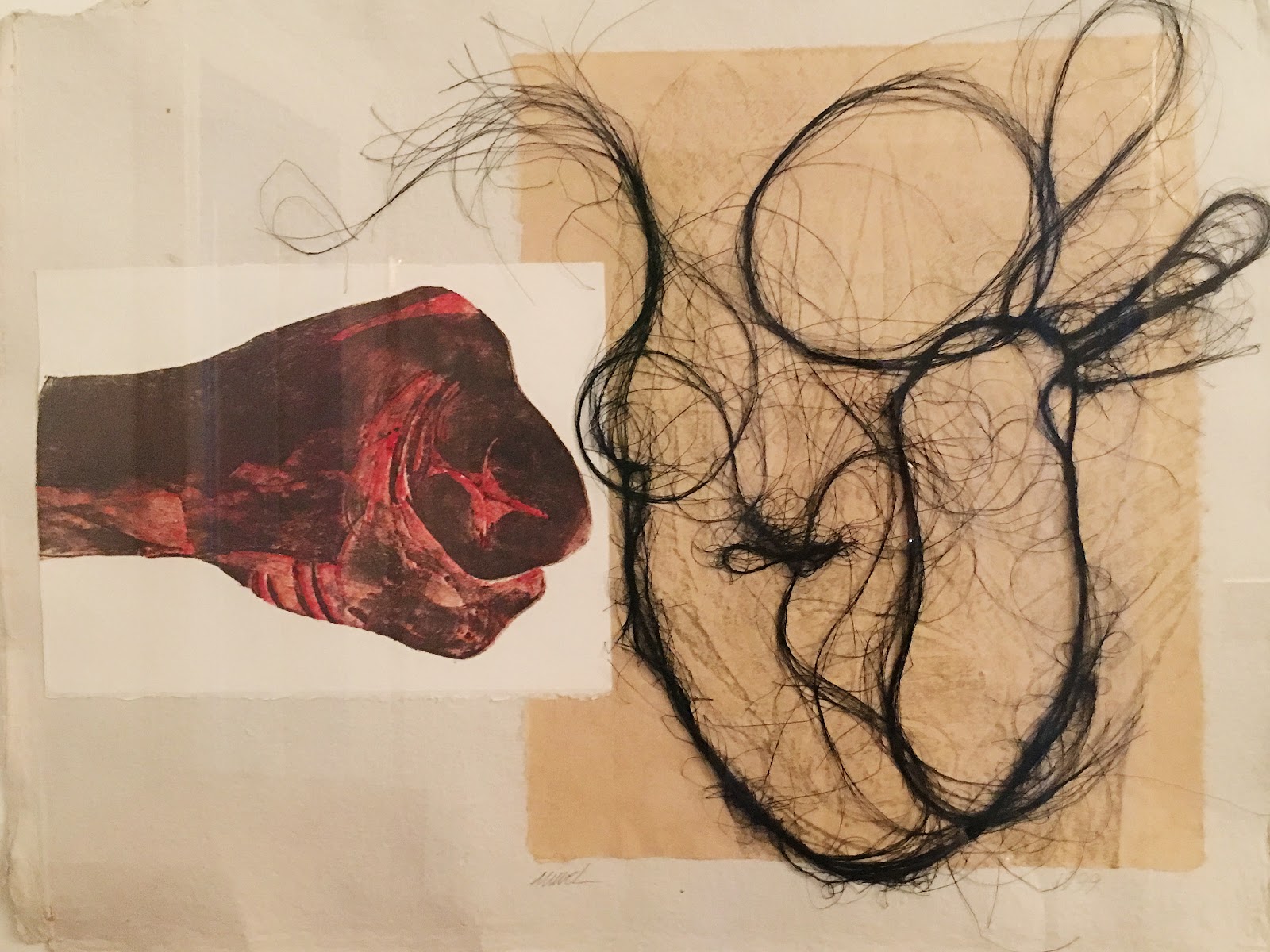
Mary Valverde’s intricate and ephemeral ink drawings; and
the dark but funny collages of Melissa Stern, who describes her own work as
“childlike and goofy.” Stern’s wry, ironic bricolage creations, like “New
Boyfriend”

Melissa Stern, New Boyfriend”
(2017, paint, collage, graphite)
bring together anthropological depth and an unexpected
intimacy to comment on life’s absurdities.
There’s such great work and so much going on in this show. Unfortunately, the constraints of time and
space do not allow me to write about every artist and work. It was extremely
difficult to limit my choices because there are so very many works worthy of
contemplation. The Big Small Show 2017 delights, inspires, and illustrates the
vast, far-reaching range of artistic expression.
The Big Small Show 2017, a recent survey of drawing, painting, sculpture, photography and print at Drawing Rooms by 102 NJ/NY metro area artists in 8 gallery rooms, the hallway and gallery shop, is curated by Anne Trauben and will run through 2/17/18.
Artists in The Big Small Show 2017 include:
Alejandro Rubin Panvini, Alice Momm, Alpana Mittal, Amanda Church, Andra Samelson, Ani Rosskam, Ann Giordano, Anne Q. McKeown, Anne Trauben, Annie Varnot, Ashley Lyon, Barbara Lubliner, Beatrice Mady, Bill Leech, Bill Rybak, Bruce Halpin, Caridad Kennedy, Carla Aurich, Cathy Diamond, Christopher Lowry Johnson, Curt Ikens, Dana Kane, David French, Deanna Lee, Deirdre Kennedy, Diane Tenerelli-June, Donna Conklin King, Eileen Ferara, Fran Beallor, Gary Petersen, Greg Letson, Ilene Sunshine, Injoo Whang, Jackie Shatz, Janet Pihblad, Janet Tsakis, Jeanne Heifetz, Jeanne Tremel, Jennifer Krause Chapeau, Jodie Fink, Joe Lugara, Jong Hyun Kwon, Josef Zutelgte, Julian Jackson, Justin Pollmann, Katarina Wong, Katherine Jackson, Katherine Parker, Kathy Cantwell, Katrina Bello, Kit Sailer, Laura Alexander, Laura Lou Levy, Linda Gottesfeld, Linda Schmidt, Lisa Pressman, Lisa Sanders, Liz Atlas, Loura van der Meule, Lucy Meskill, Maggie Ens, Marianne DeAngelis, Marietta Hoferer, Mary Valverde, Maureen McQuillan, Melissa Stern, Michael Endy, Michael Kukla, Michael Moore, Michael Teters, Mona Brody, Nan Ring, Nancy Karpf, Nikolina Kovalenko, Noemie Jennifer, Nupur Nishith, Pam Cooper, Pamela Shipley, Patricia Fabricant, Pauline Galiana, Rajendra Mehta, Rene Lynch, RitaMarie Cimini, Robert Egert, Robin Feld, Roger Sayre, Ruth Hiller, Sarah Lutz, Stephen Cimini, Steve Krasner, Sue Ellen Leys, Sunjin Lee, Tamar Zinn, Terri Amig, Tessa Grundon, Theda Sandiford, Todd Lambrix, Trix Rosen, Wendy Letven, Yael Dresdner, Yuko Nishikawa.
THE BIG SMALL SHOW 2017, 12/15/17 - 2/8/18 is curated by Anne Trauben.
Lindy Judge is a writer and editor. Read her bio here.
Alejandro Rubin Panvini, Alice Momm, Alpana Mittal, Amanda Church, Andra Samelson, Ani Rosskam, Ann Giordano, Anne Q. McKeown, Anne Trauben, Annie Varnot, Ashley Lyon, Barbara Lubliner, Beatrice Mady, Bill Leech, Bill Rybak, Bruce Halpin, Caridad Kennedy, Carla Aurich, Cathy Diamond, Christopher Lowry Johnson, Curt Ikens, Dana Kane, David French, Deanna Lee, Deirdre Kennedy, Diane Tenerelli-June, Donna Conklin King, Eileen Ferara, Fran Beallor, Gary Petersen, Greg Letson, Ilene Sunshine, Injoo Whang, Jackie Shatz, Janet Pihblad, Janet Tsakis, Jeanne Heifetz, Jeanne Tremel, Jennifer Krause Chapeau, Jodie Fink, Joe Lugara, Jong Hyun Kwon, Josef Zutelgte, Julian Jackson, Justin Pollmann, Katarina Wong, Katherine Jackson, Katherine Parker, Kathy Cantwell, Katrina Bello, Kit Sailer, Laura Alexander, Laura Lou Levy, Linda Gottesfeld, Linda Schmidt, Lisa Pressman, Lisa Sanders, Liz Atlas, Loura van der Meule, Lucy Meskill, Maggie Ens, Marianne DeAngelis, Marietta Hoferer, Mary Valverde, Maureen McQuillan, Melissa Stern, Michael Endy, Michael Kukla, Michael Moore, Michael Teters, Mona Brody, Nan Ring, Nancy Karpf, Nikolina Kovalenko, Noemie Jennifer, Nupur Nishith, Pam Cooper, Pamela Shipley, Patricia Fabricant, Pauline Galiana, Rajendra Mehta, Rene Lynch, RitaMarie Cimini, Robert Egert, Robin Feld, Roger Sayre, Ruth Hiller, Sarah Lutz, Stephen Cimini, Steve Krasner, Sue Ellen Leys, Sunjin Lee, Tamar Zinn, Terri Amig, Tessa Grundon, Theda Sandiford, Todd Lambrix, Trix Rosen, Wendy Letven, Yael Dresdner, Yuko Nishikawa.
THE BIG SMALL SHOW 2017, 12/15/17 - 2/8/18 is curated by Anne Trauben.
Lindy Judge is a writer and editor. Read her bio here.