Showing posts with label Megan Klim. Show all posts

Wednesday, November 15, 2017

Constructed Space, 10/24/17 - 11/29/17, at Lemmerman Gallery, NJCU

by Megan Klim
11/15/17

What compels artists to painstakingly create alternate realities and spaces? At the exhibition Constructed Space, curated by Midori Yoshimoto, Ph. D., four artists specifically take on this quest with different approaches that are all fascinating and unique. With some of the work, the process is not immediately known, yet hints at something otherworldly, dreamlike and surreal, while other works lay it all out deliberately and concretely. Regardless, this exhibition forces us to pause and wonder about the spaces we create as humans, while addressing the desire to re-create and manipulate them.
Curt Ikens.jpg
Curt Ikens  “Platform for a Skeptical Constituency”
IMG_1293 2.JPG
Curt Ikens, Detail of “Unpleasant Enough”

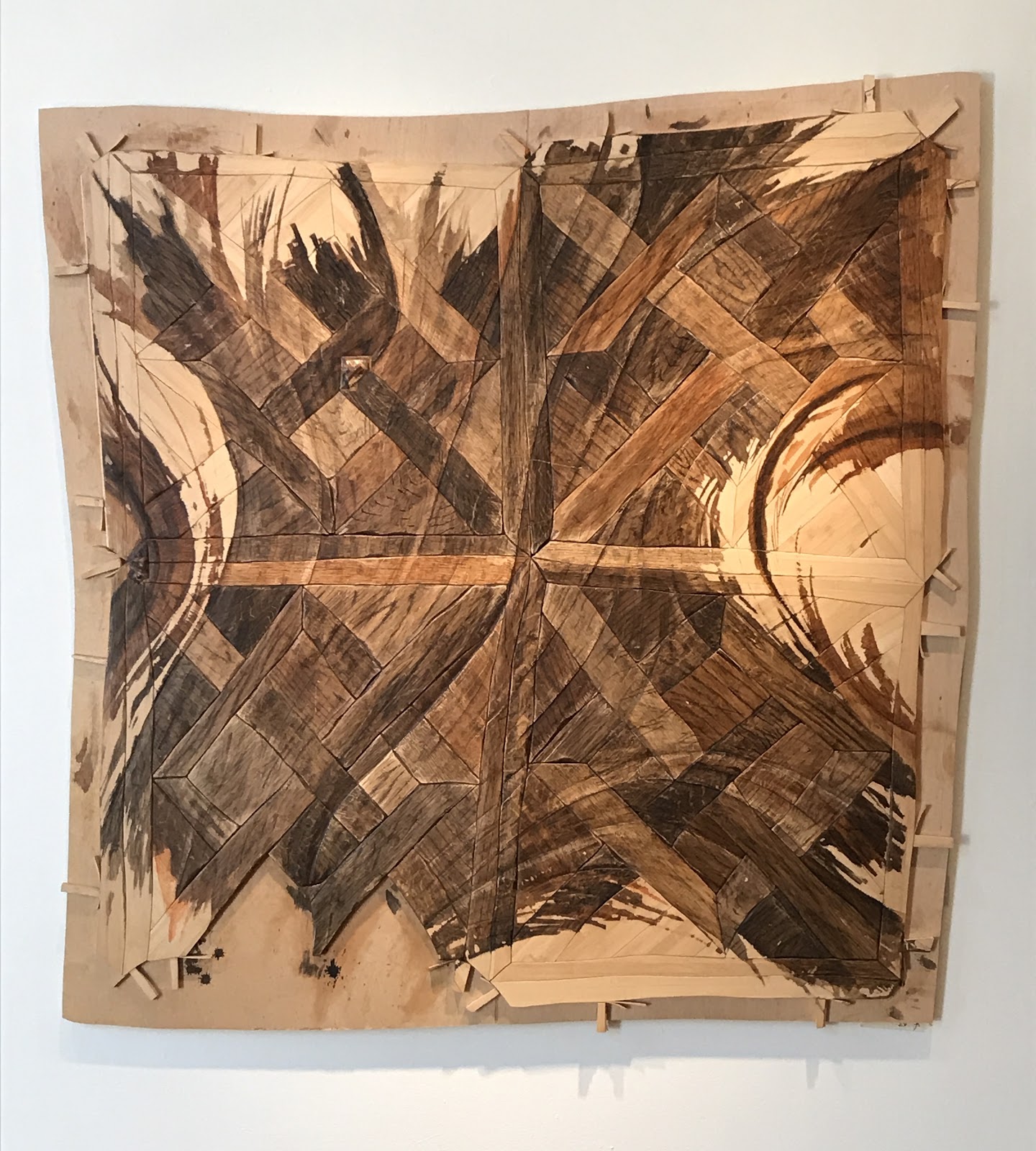
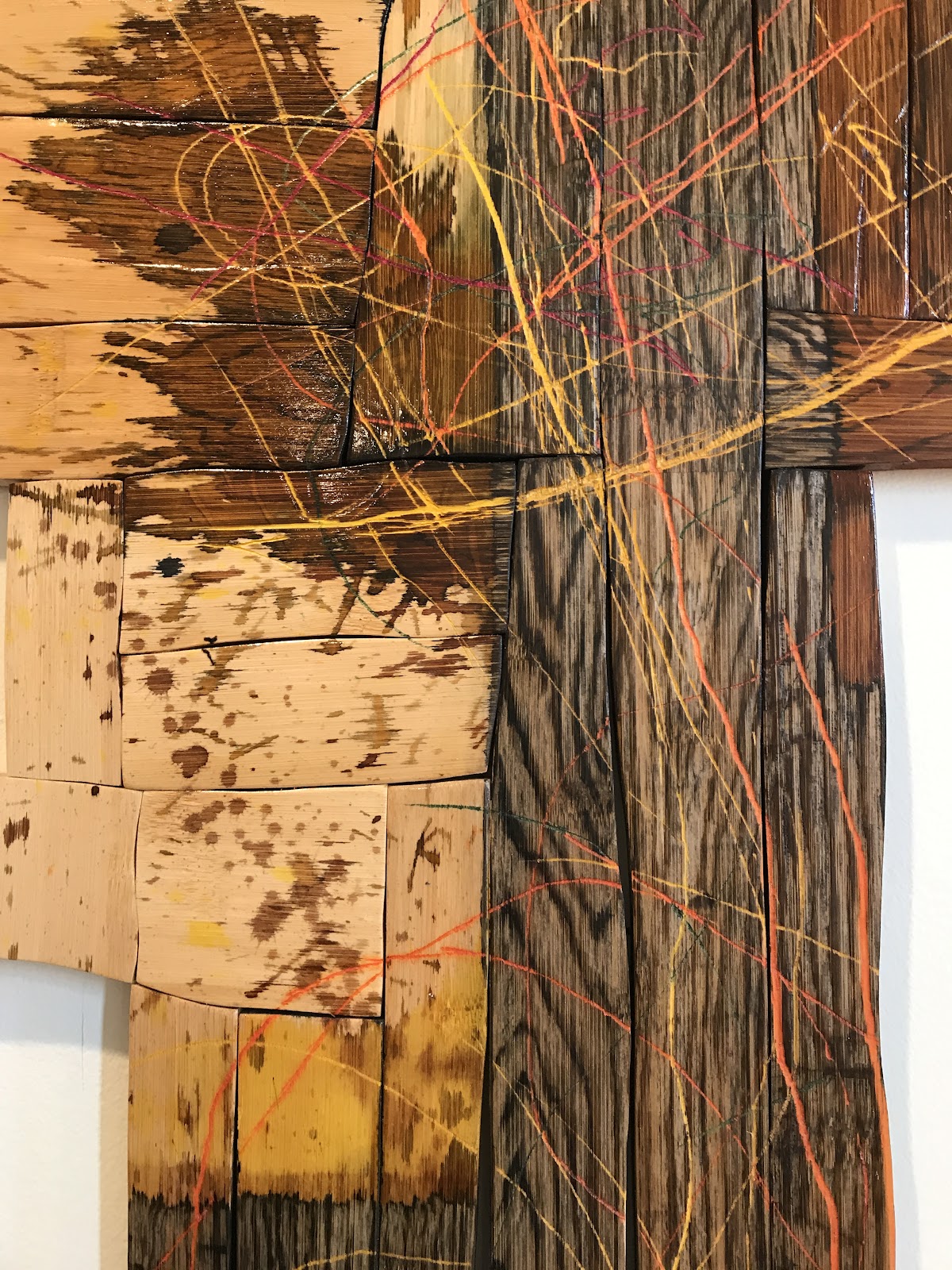
Curt Ikens’ work is one which invites the viewer into his process- all layers of it. One of the pieces “Platform for a Skeptical Constituency” is on the floor and built into the corner. The outer edges show the bottom plywood, then the unstained wooden planks on top, which slowly become fully stained and more organized and even contain some inlaid detail toward the corner. I really enjoyed this visual experience which isolates each component while also working as one piece. Another piece (pictured below) “Figments of Forefathers”, takes a big square of flooring and hangs it as an object. The organic shape reminded me of a wooden quilt. Instead of stitching, we see his hand with stain swipes, and an irregular joining of the wood. In other works, he has scratched in color which suggests a primitive scrawl that one would find when an errant child found a crayon. Ikens' relationship with wood is authentic and palpable- he honors the structure of the wood and is also compelled to dismantle it.

Kim Keever  “Blue Delta”

Kim Keever’s work is completely the opposite in approach. His dreamy landscapes and spaces make us wonder exactly where this place is- when in fact it exists nowhere other than here. There is a removed quality to the work– as if we are viewing it through a decidedly murky lens. Keever’s process is opaque and one would not guess it without explanation. These are not “real” landscapes at all; they are totally artificial detailed miniature scenes submerged in a 200-gallon water tank and then photographed. Even knowing this information, I struggled to see them as “unreal”. This work really provokes us into thinking about illusion, realities and actuality. In “Blue Delta” (below), we are taken down the “river” and through the “hills” while looking at a majestic glowing “sky”. Keever creates his own personal and ethereal world that has never existed until now, and by doing so, challenges us to think about landscape and its definition.


Martin Kruck "Cell"

Martin Kruck’s work plays with space. He juxtaposes an image with a location which, when viewed together, create an unexpected interior. Unlike Keever’s work, Kruck's locations do exist in reality- he reinvents and manipulates them into a whole new space. His art examines that initial space and alters it by adding in elements that play off each other resulting in a whole new perspective. In “Savoy”, he places a classical sculpture in a medical examining room for great apes. The grid tiled room is accentuated with the presence of the sculpture that stands over a cement slab. A twinkling dust-like material is in the atmosphere; giving this stark composition a hint of surreal magic. In “Cell” (pictured below), Kruck uses formal elements simply and effectively. The rough texture of the enclosed space envelopes the billowy cloud. The white geometric opening counters with the ethereal puff, while balancing the shadow at the bottom. Here we have heavy vs. light, and open, yet enclosed. Kruck plays with a space that on its own looks uninviting and grim, and then transforms it with the visiting cloud which simply hovers there as a hopeful intruder, bringing air and lightness to an otherwise claustrophobic, empty existence.

Jeremy Coleman Smith  “Cross Section:  Bottom Shelf”

Jeremy Coleman Smith’s work offers a domestic narrative. Smith recreates and elevates mundane scenes out of man-made materials, such as cardboard, paper and foam-core. These materials are usually of little value, but they ultimately assume the qualities of the original objects. By having all components fabricated in this manner, Smith invites the viewer to think about what these scenes or objects can mean, rather than what they are. The reality of the object is removed, stripped away, thus forcing us to ponder their significance or rather the significance we ourselves assign to them. In “Cross Section: Bottom Shelf”, Smith recreates a kitchen sink area. Upon close inspection, we see the sink is paper with the paper seams in viewa purposeful reveal of the hand-made. We also notice that he pays attention to detail by simulating the textures on the paper rubber glove and sponge in the sink. On the bare counter sits a wine bottle-shaped ceramic piece, and above that is, perhaps, a half-drunk glass of wine strategically perched on a window ledge. This is where it gets intriguing, as the artist leads us through the slightly obscured glass to a marsh-like, mysteriously lit landscape, which transports us out of the interior and into what lies beyond the mundane. 

Constructed Space, 10/24/17 - 11/29/17. The Harold B. Lemmerman Gallery, New Jersey City University, features work by Curt Ikens, Kim Keever, Martin Kruck and Jeremy Coleman Smith. The exhibit is curated by Midori Yoshimoto, Ph.D.

Monday, November 13, 2017

On a Different Page, 11/9/17 - 12/14/17, at Visual Arts Gallery, NJCU

by Megan Klim
11/12/17

The current exhibition on view at the Visual Arts Gallery reminds us that a book can be a cherished object not only for its story, information or message but as an intriguing piece of art that commands close inspection. Curator Eileen Ferara has smartly assembled a diverse group of artists that has interpreted the book by either altering them, paying homage to a classic, making a statement or re-imagining what possibilities a book can hold. 

Books are usually mass-produced; but artists' books are mostly one of a kind objects removing that aspect, therefore punctuating their individuality and uniqueness. I was curious to see this exhibition for a couple of reasons: I like the work of the artists chosen and am drawn to the idea of a book as a sculptural item. This exhibition is a well-rounded representation of the various ways a book can be viewed that also celebrates the book as object.  

Participating Artists in the exhibition are Aileen Basis, Kate Dodd, Asha Ganpat, Jaz Graf, Carole Kunstadt, Winifred McNeill, Ibou Ndoye and David Sandlin.

Read the rest of the review here.

Wednesday, August 30, 2017

Friday, August 11, 2017

NJCU MFA Dress Rehearsal, 7/28/17 - 8/12/17, at Drawing Rooms

by Megan Klim
8/11/17


The concept of a “Dress Rehearsal” exhibition is somewhat novel for candidates working towards their MFA, since usually, it is after a thesis is completed that the work is exhibited. This approach, which was deftly curated by Anne Trauben and hosted at  Drawing Rooms in Jersey City, offered not only a glimpse into the artists’ current thinking, but also offered a sneak peek into their developing processes and in one case, to an already established artist. As an MFA candidate, it can be a vulnerable time for finding your voice. Here, some artists were more on target than others, yet, as a whole, the exhibition showed depth and promise. Regardless, it was a welcomed opportunity to see these artists during this personal period of exploration. The candidates are: Alejandro Rubin, Duda Penteado, Marco Cutrone, Maria Tapia, Michael Barreto, and Rachel Kehoe.


FullSizeRender (5).jpg Michael Barreto

Michael Barreto’s work spoke to uncertainty yet fortitude at the same time. His layered somewhat chaotic backgrounds were punctuated with clean looking stenciled text with catchphrases heard often.


Polarized statements such as “Believe you Can and You’re halfway There” lived on the same picture plane as “Post No Bills” adding a contradictory slant. The artist also used objects with text, with one having 5 very worn-out work gloves, man-sized, with the word DEADBEAT stenciled at the bottom. I found this piece to be the most visually pleasing with its earthy undertones, while being intriguing as I tried to make connections to the very used gloves and to the text that perhaps suggested otherwise. I am curious to see where he brings his interplay of text, object, and surface next.


FullSizeRender (3).jpg Alejandro Rubin

Alejandro Rubin’s work was intimate and personal without much fanfare. A swimmer, I could easily see his direct connection to his digital prints of the sea in his homeland of Venezuela. Some photos were cropped and some filled the whole frame. The images were seductive and took on a material feel; almost like an eraser drawing with the blurred edges of the changing sea with areas of depth. One could get lost looking at the subtle tones of the water and it’s immense power through the stopped action of its movement, while also bringing the viewer to a quiet veneration. Rubin also had an installation across the hall, which invited the viewer to sit in a welcoming leather chair facing an old-school small TV looking monitor that showed his sea pictures in an almost imperceptible loop forcing the viewer to take an even closer look. There was a wind-like sound in the background, which turned out to be a passing train– perhaps a nod to urban life vs. the solitude one feels staring at the vast sea. Directly in front of the chair on some sand, a large metal bin filled with water was placed to soak your feet as you ruminated on the pictures. Rubin created a relaxed, yet controlled environment for us to honor his images, while inviting more of our senses.


FullSizeRender.jpg
Rachel Kehoe

With Rachel Kehoe’s work, I was intrigued and perplexed simultaneously. Kehoe took old paintings, the kind you find in a thrift store, and altered them by painting in her own imagery. For example, one landscape had a flying saucer (added by her) in a wooded area. In another, she added the famous “Starry Night” sky by Van Gogh to an already thickly painted landscape. There was no real attempt to integrate the already given style of the original paintings which only separated the additions further.  She states “kitsch” in her statement, but I saw no solid commitment to that stance. Also, in some paintings, the original artist's names were either lightly blurred out, crossed out more fully or not at all. I couldn’t see a connection to why this changed from piece to piece. There were, however, notable attempts to use famous imagery (Van Gogh, Toulouse-Lautrec). Some imagery felt random– as if she was simply taking an already existing painting as her “ground” and inserting things without any clear direction or connection to the original. But, in one she had great success. The colorful post-modern crisply painted dots placed over a drab mono-toned still life soared. Here, she created tension while having a conversation with what existed underneath. This piece considered the original and played off it in a visual, formal and historical way. I hope she continues in this direction.


FullSizeRender (1).jpg Maria Tapia

As can happen when an artist seems to be exploring their work, I saw two different approaches in Maria Tapia's gallery space. The left side of the room had some imagery (crosses, symbols), mixed media (yarn), while the other had mostly simple, painterly abstractions which were where my eye was held. Tapia writes that she wants to create “Narrative Atmospheres” and with these 4 pieces, she has. These pieces looked like she had fun while making them with the creamy patches of paint, touches of color and brush marks dancing the plane as visual stepping stones to carry us through. These paintings offered us a tactile experience– simply and without fuss. I think Tapia hasn’t made the decision just yet which route to take, but I hope she trusts her instincts to have the materials speak on her behalf.


IMG_0822 (1).JPG
Marco Cutrone

As soon as I entered Marco Cutrone's room, the words “The Male Gaze” came to mind. These skillfully, realistic and carefully crafted paintings all showed beautiful women in various poses with mostly sparse Hopper-esque backgrounds. What I found immediately interesting was the fact that of all 8 pieces– only one woman looked at the viewer. The others were turned inward, looking away pensively or to our backs. There was a voyeuristic quality to this work– as if someone uninvited was the careful observer to women unaware, yet also a quiet interplay of honoring the subjects. One in particular, “A Bed of Roses”, caught my attention. The space Cutrone created was awkward and unsettling. Is she sitting? Laying down? And why were her hands placed in that manner? The highly rendered floral background really showcased the figure here. Overall, these pieces felt somewhat staged, punctuating a sense of detachment as one retreats into their own thoughts.


FullSizeRender (4).jpg Duda Penteado

As an already established and successful artist, I was really curious to see how Duda Penteado’s work would shift under the framework of an MFA program. Having been familiar with this artist’s previous work, I saw the same palette and energy, yet this work seemed more pared down and singular. Penteado’s shapes teeter between biomorphic and structured that live in that un-named space in between. His stacked shapes reminded me of a Jenga game tower that was more writhing and unstable, yet would stay standing with the strength of its determination. Penteado is a master of offering up a color experience mixed with shiny metallic areas and black outlining. His shapes are his own– a mixture of body parts, architecture and pattern with portals into them. Penteado’s work tackles big ideas of humanity and purpose resounding with joy and angst which provide a full experience.


NJCU MFA Dress Rehearsal at Drawing Rooms, 7/28/17 - 8/12/17, at Drawing Rooms, features drawing, installation, painting, photography and sculpture by Alejandro Rubin, Duda Penteado, Marco Cutrone, Maria Tapia, Michael Barreto, and Rachel Kehoe. The exhibit is curated by Anne Trauben. Megan Klim is an artist. Read her bio here and view her website here.