Showing posts with label Nature. Show all posts

Saturday, June 29, 2024

Color, Shape, Line: Six Degrees of Separation between Andrew Zimmerman, Fran Shalom and Jesse Hickman, The Terrarium Gallery at Drawing Rooms, 5/18/24 - 6/29/24

Response to “Color, Shape, Line: Six Degrees of Separation between Andrew Zimmerman, Fran Shalom and Jesse Hickman”, 5/18/24-6/29/24
Curated by Anne Trauben.
By Andrea Epstein
6/27/24

“Color, Shape, Line: Six Degrees of Separation between Andrew Zimmerman, Fran Shalom and Jesse Hickman”, curated by Anne Trauben, is showing in the Terrarium Gallery at Drawing Rooms. The three artists in this group exhibition exemplify three very distinct and original approaches to abstraction featuring a formal and elemental approach to painting, drawing and sculpture in it’s purest form. Although each artist has a truly unique approach to their own practice, what struck me immediately on entering the exhibition space, was the synchronicity between the work. There is such an affinity between all 3 artist’s sensibilities, so that the individual pieces create a wonderful visual conversation that felt very impactful to me. The insightful and careful curation by Anne Trauben clearly places emphasis on the shared visual elements in the work as a group. The press release states, ”Each artist explores the formal qualities of color, shape and line in a playful handmade way”. 

The playful, whimsical, qualities in Fran Shalom’s paintings are immediately apparent in her animated bright color choices which evolve from a very layered build up of paint over a period of time, as well as the quirky and totally unique shapes that reference aspects of the human body, but are also very ambiguous and open to interpretation as objects or other beings altogether. The artist describes the paintings as, ”ambiguous characters who inhabit my studio, keeping me company and often engaging in silent conversation.” This statement expresses exactly my gut response to these beautifully crafted paintings. I saw them as individual beings reaching out from their square confines, speaking to each other, the other artworks and to me. They tell a story of color, line and shape that has a personal narrative all its own.  

The concept of the pared down shapes taking on an animate personality is particularly evident in the paintings, “Shoot the Breeze” in which a flesh and maroon striped horizontal curvilinear shape protrudes ¾ of the way down from the curved irregular large orange oval shape which clearly refers to a human profile with a cartoon like bubble.


Fran Shalom, Shoot the Breeze, 24x24, oil on wood, 2023

This painting is adjacent to a piece by Andrew Zimmerman, “Every Other”, a small arched shaped laminated wood wall sculpture painted with vertical stripes with a high gloss automotive paint in a color scheme of deep rich brown and Indian red that very strongly echoes the palette in “Shoot the Breeze”. 


Andrew Zimmerman, Every Other (side view), 11 x 8in, Automotive Paint on Wood, 2023

A beautiful example of the shared formalities and similarity in shape, line and color is where two of Fran Shalom’s paintings, “Sashay” and “Go-between” both 24X24’ squares share a wall with Andrew Zimmerman’s large shaped painting, ”Mitten”. Whereas in Zimmerman’s large construction composed of four separate organic and geometric pieces joined together in a subtle yet quirky arrangement, the entire piece is covered with white automotive paint rendering it with a slick smooth surface. At first glance it seems that Zimmerman’s assemblage of shapes should be seamlessly attached, but on closer inspection it becomes obvious that the artist is very deliberate in his use of irregularity and possibly accident when it comes to where the edges meet. The artist describes his approach: as an exploration of “the intersection between painting and sculpture, art and design, the hand made and the mass produced” Zimmerman explains that when fabricating the sculptures and wall constructions, he uses hand held woodworking tools that create variations in line that amplify the unique hand of the artist. All three artworks share the use of the color white. In Shalom’s two paintings, the white is used as accents that form a strong contrast with the greens and black of the larger shapes and backgrounds, creating a striking figure ground dynamic.


Fran Shalom, Sashay, 24 x 24 in, oil on wood, 2023


Fran Shalom, Go-Between, 24 x 24 in, oil on wood, 2022

Andrew Zimmerman, Mitten, 48 x 36 x 1.5 in, automotive paint on wood, 2024

Throughout the installation of these three abstractionists, one can really contemplate the significance of the varied treatment of edges and the essential defining role they play in these artist’s works. As far as the treatment of the surfaces themselves, there are also many delightful surprises. On first encountering Fran Shalom’s paintings as a group and at a distance, I concluded that the surfaces were more uniform and smoother then they are. After studying them up close and taking the time to really look, one can see that there is a profound history of layers of built up oil paint that also reveal subtle variations in brushwork, texture and color with lovely surprises lurking beneath the surface.

Speaking of variations in surfaces brings me to the work of Jesse Hickman. Hickman’s paintings which utilize black acrylic and charcoal drawn or painted on burlap mounted on wood rectangles and squares also struck me as very minimal at first glance, but the use of the unconventional material of the recycled burlap bags imbues his pieces with a very immediate textural essence that is also surprising, playful and fun. The curator, Anne Trauben, did a wonderful job of displaying three of Hickman’s paintings (which were not conceived or created together) as a group, which really made the individual pieces sing for me. The grouping composed of, “An Interrupted Arc and the Number of Times I Peed Within a Square and a Rectangle”, on the top left, “An Egg and Arcs Within a Square and a Rectangle”, on the top right and “Emphatically Within A Square And A Rectangle”, anchoring the group on the bottom, allows the viewer to see the lyricism of the linear elements, the ovals, half circles, and the color within the monochromatic textured rectilinear format and is thus transformed. A very important part of Hickman’s practice are daily drawings, nine of which are also displayed in lovely groupings that document the artist’s process, also very compelling in their own way.   


Jesse Hickman, charcoal and acrylic on burlap, 2023 

The vibrant synergy that exists between all three artist’s paintings. sculptures and drawings is clearly illustrated in how they employ irregular organic shapes, deeply felt definition of line, limited palettes, and the essential role of the edges in all the artworks. Although one can enjoy each artists creations as individual pieces, the most exciting aspect of this installation is the way the paintings, sculptures and drawings are grouped together, how beautifully they echo each other and make more visible the formal components of pure abstraction that each artist explores in their particular processes. I have to confess, on first entering the gallery, apart from my immediate response to Shalom’s beautiful bright, unusual colors and quirky animated figures, I thought the work was very minimal. But on closer observation and careful looking, I found that there is nothing about this show that is minimal at all.  

Color, Shape, Line: Six Degrees of Separation between Andrew Zimmerman, Fran Shalom and Jesse Hickman is on view at The Terrarium Gallery at Drawing Rooms through 6/29/24.

Andrea Epstein is a painter and printmaker who creates vibrant abstract mixed media works on paper incorporating a variety of printmaking techniques in her own print studio in Berkeley Heights, NJ. Learn more about Andrea here.

Saturday, July 1, 2023

NJ & Me: Imperfect Together, 5/25/23 - 7/29/23 at The Terrarium Gallery and The Alcove Gallery at Drawing Rooms

Imperfect Impressions: NJ and Me…
by Peter Delman
6/26/23


In the climactic final scene of Steven Spielberg’s semi-autobiographical film The Fabelmans, the young aspiring filmmaker meets the cranky legend John Ford. Ford (played by David Lynch, of course) has only patience enough to share one piece of wisdom with the neophyte: “The horizon at the bottom of the frame is interesting. The horizon at the top of the frame is interesting. The horizon in the center is boring as shit!”

The artists in NJ and Me: Imperfect Together embrace this lesson, no doubt without coaching from a cantankerous maestro. There’s hardly a middling horizon in sight, and glorious skies and evocative foregrounds are the result. Tim Daly’s low horizons and big skies give his luminous clouds room to roam. In Tim Heins’ Dusk, Jersey City, bands of enigmatic color blaze like chevrons across a banner of sky.

In movies the high angle (horizon at the top) is used to express vulnerability. In Dorie Dahlberg’s stark beach scenes, Love Before COVID 2 and New Year’s Day. Will This Be the Year?, a few isolated figures brave the cold winter winds in a vast expanse of sand. In contrast, the sun shines bright in the beach paintings by John Meehan III and Sue Ellen Ley. In Meehan’s Safari Towel the looming Dad silhouette balanced by the crouching figure in shadow gives the painting an extra jolt of Baroque energy.

Lots of attention is paid here to New Jersey’s urban scene, though just about everyone wisely gives contemporary architecture a wide berth. Alan Ostrowski’s loving drawings of the Bayonne bridge sparkle. Kevin McCaffrey’s Hoodsin County is an understated send-up of historical maps. You need to pay close attention to catch all the playful humor in this and his other works. McCaffrey cites Finnegan’s Wake as a major influence on his process. His lodestar is Joycean stream of consciousness, and these images deliver unpredictable surprise—even to him. The plot thickens when he discusses his former life as a Dominican priest, and there’s the flawless rendering of the map itself, which even divine inspiration can’t account for.

Anne Trauben’s portraits of Jersey diners capture the full brilliance of their iconic neon signs. (Kudos to Trauben for curating this ambitious, intelligent exhibition.) Christopher Z. is also intrigued by signs, which flow across his drawings with the grace of water. James Pustorino’s Wildwood photographs celebrate the engineering of some of our most gonzo, loopy creative minds. It’s a pleasure to see this gem of pop culture still preserved and being enjoyed to the hilt.

In Photo Sculptura 2, Jean-Paul Picard uses a glass brick wall as a ready-made distortion filter. There are echoes of art history evident here—cubist fragmentation, surreal mystery, the grid. But in the end, thanks to the instant karma of the camera shutter, the image is an up-to-the- 
minute shining artifact of the present.

“Sign on the window says lonely” is my favorite opening lyric by Bob Dylan—an apt tag line for New Jersey, to judge by much of the work in this show. The few figures on Dahlberg’s beaches punctuate their bleak emptiness. Tim Daly’s highways are more deserted than in the first week of COVID lockdown. No one ventures out onto the spooky dollhouse streetscapes of Jessica Rohrer’s Precisionist paintings. Rohrer describes these immaculate streetscapes as “sanitized” and “disturbing,” and agrees that The Rapture might conceivably begin on her block. They are based on drone stills, which may have something to do with why they bring to mind films like Blue Velvet and The Truman Show.

Lauren H. Adams goes right for the heart of desolation. Her discarded couches are a lesson in how mute objects are capable of speaking to us with achingly poignant eloquence.

I went to college in Vermont. My freshman-year student dorm counselor was from Oklahoma. He was very impressed with lush Vermont, but took great delight in mocking New Jersey as “the armpit of the nation.” I didn’t know then that much of the Garden State is just as green as the Green Mountain State. As for Oklahoma, it’s presumably OK.

Forty percent of New Jersey is forested, and several artists here speak for the trees.  Doug Madill’s painting of Leonard Gordon Park captures, with expressively assured brush strokes, the golden light of a summer evening on urban trees. Edward Fausty’s exquisite photographs of woodlands are a moving testament to what we have and what we stand to lose—elegiac 
reliquaries for precious fragments of the true world. He describes his spherical images as evoking the experience astronauts have viewing the earth—"a living rock floating in the black void.”  Fausty knows what it is “to see the world in a grain of sand.” 

Viewing Eileen Ferara’s painting of the Hudson estuary, we imagine for a moment that the turbulent, unruly forces of nature have the power to hold at bay the “dark Satanic Mills” lurking in the background. I see Anne Percoco’s gentle installation Heap II as a riddle or koan: “when is a leaf not a leaf?” Is the pile of leaves, meticulously fashioned from paper street litter, a reproach, or something more ambivalent? So it goes in our imperfect New Jersey state of mind.

NJ & Me: Imperfect Together is curated by Anne Trauben.

Peter Delman is an artist living in Jersey City. Read Peter's bio here and view his artwork here.

Learn more about the exhibition and view images on Drawing Rooms website here.

Wednesday, October 11, 2017

Sup-A-Genius: The Five Guy Show, 9/22/17 - 11/11/17, at Drawing Rooms

Harvest/Time
by Kate Dodd
10/11/17

All of the works in Sup-A-Genius, a show of five installations currently at Drawing rooms, deal with aspects of harvesting and time. The artists were all selected because of their tendency towards work that “works”, that labors and produces, as any good invention will. These are makers making something make something else, and as such, it is worth looking at both their process and their product.


Joe Chirchirillo

Joe Chirchirillo has been making heavy-duty sculpture for a long time. Here he puts his collection of implements to use to create a water cycle, aka a gravity-fed fountain that fills the room with a sort of creaky bucket brigade made up of old farm containers. In one corner, a separate mechanism spins sporadically, marked by a propeller wing labeled water on one side and wind on the other. Its laconic movement, along with the complex arrangement of the aged vessels, creates a sense of abandonment, as if the resources of wind and water have dwindled to a trickle, and all that’s left is the labor of this mechanism, determined to continue regardless of the existence of any resources, while the repeated sound cycle marks the ceaselessness of time passing.


Anthony Fisher
Anthony Fisher has drawings and a video showcasing his process, along with some of what might be his drawing tools, on display. The black and white drawings range in scale; all feature mysterious marks, some made up of several drawings that are inlaid into each other. Delicate lines wrap around themselves on a ground that looks tough, grey, pocked by grit. This toughness connects to the brutish tools nearby, made up of weights and wheels on brooms. The video of Fisher arduously pushing heavy implements over paper on his studio floor supplies the link that reveals his process. Jackson Pollock meets Chris Burden. One could consider these drawings machine-made, albeit with significant labor on the manufacturer’s part, with the traces of the tools’ movement as the product being created; Fisher then “harvests” the raw material he has cultivated and fashions it into drawings and collages, elegant records of sheer willpower.


Roger Sayre

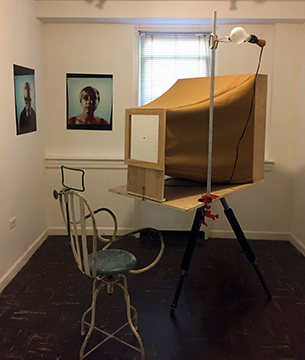
Roger Sayre actually uses his room as his portrait photography studio, complete with a refurbished clinical chair for clients and a large pinhole camera. The challenge here is to sit still enough, long enough, while staring at oneself in a mirror Sayre has rigged up, to result in a fixed image. A conflated Warhol Screen Test of sorts. Portraits done in this manner line the walls, in both black and white and color, each seeming to reveal its subject as if through a long journey from a distant place. The color portraits, in particular, refer to the myth of Narcissus, with the liquid-y backdrop suggesting that we’re actually peering through water at the subject floating beyond us, a reflection but not the real thing. These are the opposite of selfies; they require an attempt at introspection on the part of the subject rather than the masked pose marking one’s non-present presence at places or events of note. Sayre is distilling the essence of time spent with a disciplined will.


Kurt Steger

Kurt Steger’s work asks participants to give freely and endlessly of their time as well, although one would not know it by looking. His drawings of perfect circles in rich earthy hues on immaculate white paper make one think of a highly singular force.  The controlled drops of toxic water that create these rings contradict the purity of form, but don’t reveal the communal process required to manage such exactness. To create these, Steger asks participants to tend to the melting drips at the end of a swinging plumb line by rotating the paper surface that they land on; he hopes to create a communal experience reminiscent of tending a fire while sharing stories and wisdom. He has set up a contraption to illustrate this, although its diorama-like scale leaves it functionless, making the connection between the vagaries of people’s informal communal abilities and the refinement of Steger’s circles hard to reconcile.


John Morton

Fittingly, John Morton’s audio installation challenges us to not only participate in this harvesting of human will, but to believe in it as an action that will yield results. Belief is the subject of Fever Songs, a series of recordings of spiritual ecstasy from cultures around the world. As with other proximity sensor-driven pieces, this one requires experimentation and patience. Without enough movement around the room, aka participation on the part of the viewer, the sounds retreat to silence, possibly beckoning you back only as you walk out the door. The absence of voices prompts one to try again, to actually have faith that one’s presence is the thing that initiates action, a clear parallel to engagement with spiritual practice. The sensor acts as a god, reflecting back whatever one is willing to invest.

Each “Sup-A Genius” invention in this show suggests that a process will produce a product. Whether Sisyphean or hopeful, all of these works evoke a sense of effort, of sheer will, of “I will make this happen despite all odds” adding up to a mood of eloquent desperation in a world where effort doesn’t necessarily determine the outcome.

Sup-A-Genius: The Five Guy Show, 9/22/17 - 11/11/17, at Drawing Rooms, features works by Joe Chirchirillo, Anthony Fisher, Roger Sayre, Kurt Steger and John Morton. The exhibit is curated by Anne Trauben.

Kate Dodd is an artist and an art teacher in public and private schools for 25 years. Read Kate's bio here and view her artwork here.