
Lucy Rovetto’s Career-Long Exploration on the Human Anatomy’s Response to Emotional Stimuli at Drawing Room's Alcove Gallery
By: Lumane Luma
11/7/23

On view at Drawing Rooms Alcove gallery, Exhibitions Director Anne Trauben curates the career-survey "Lucy Rovetto: For the Love of the Body" with works spanning from 1989 - 2022. The separations of decades within the exhibition displays Rovetto’s psychological response to the zeitgeist. Years 1989 and 1990 feature photographs of intimate encounters with the body with compositions that show the beauty of its form. From 1994 - 1996 Rovetto’s sophisticated artistic exploration began to formulate.

Cross-Eyed by Lucy Rovetto
In her 1994 “Cross-Eyed,” small photographs of repeated images of the nude artist laid forward are collaged in a sequence of rows. The image likeness appears as a coronary examination while the composition’s top center of the overexposed photographs are juxtaposed to appear as procedure lights seen above a patient before drifting to unconsciousness.
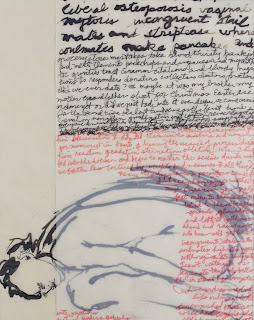
Squeeze with Words by Lucy Rovetto
In the 2010s, Rovetto’s medium focus on drawings evoked the encroaching claustrophobia of anxiety. 2014’s “Squeeze” and “Squeeze with Words'' appears as a progression of intrusive thoughts as both works are a rendition of a figure in a fetal position, though “Squeeze with Words'' is juxtaposed with illegible writing decreasing in scale to whispers as the ink goes from black to red. Also from 2014, “Facing Myself Right” is a large ink on wood outlined profile portrait of the artist that conveys Rovetto’s self-examination stripped to subtle details, a humbling confrontation of oneself to question what is the basis of identity.

For the new decade, Rovetto deters from a state of introspection, instead provoking the viewer with an unsettling scenario in "Bound", "Captured," and "Moth" which depict different perspective shots of an unidentified femme figure held restraint. The figure is sat in a chair, mouth bound with hands tied behind their backs. The viewer is a helpless observer behind the serrated screen of the grim scene. Drawn in comparison is the helplessness of observing through our devices, the chaos amidst the Covid-19 outbreak and socio-political upheaval in 2020.
Rovetto then symbolically details the gravity of emotions on the body with “Hanging Series.” Suspended from wire hangers, the works on paper appear like a play on the expression, “Hang to Dry,” which is likened to the feeling of being left to suffer alone. Of the three “Hanger Series,” Girls Got Guts (see postcard image above) is most intriguing, as it is a paper collage diagram of the viscera. It functions as an emotional signifier of our internal truth.
The dedication Rovetto has for exploring the human form has opened her horizon to utilize various forms of medium seamlessly. Each method serves its purpose for conceptual exploration from documentation in photography, psychological inspection with drawings and writing, to replicating visceral stimuli with textural 3-D materials. Rovetto’s works attune the presence of the body. The viewer is assigned the role as a test subject on nonverbal transmission. This is the basis of humanity.
"Lucy Rovetto: For the Love of the Body" will continue on view at the Drawing Rooms Alcove Gallery until November 11, 2023.

Squeeze with Words by Lucy Rovetto
In the 2010s, Rovetto’s medium focus on drawings evoked the encroaching claustrophobia of anxiety. 2014’s “Squeeze” and “Squeeze with Words'' appears as a progression of intrusive thoughts as both works are a rendition of a figure in a fetal position, though “Squeeze with Words'' is juxtaposed with illegible writing decreasing in scale to whispers as the ink goes from black to red. Also from 2014, “Facing Myself Right” is a large ink on wood outlined profile portrait of the artist that conveys Rovetto’s self-examination stripped to subtle details, a humbling confrontation of oneself to question what is the basis of identity.

Bound by Lucy Rovetto
For the new decade, Rovetto deters from a state of introspection, instead provoking the viewer with an unsettling scenario in "Bound", "Captured," and "Moth" which depict different perspective shots of an unidentified femme figure held restraint. The figure is sat in a chair, mouth bound with hands tied behind their backs. The viewer is a helpless observer behind the serrated screen of the grim scene. Drawn in comparison is the helplessness of observing through our devices, the chaos amidst the Covid-19 outbreak and socio-political upheaval in 2020.
Rovetto then symbolically details the gravity of emotions on the body with “Hanging Series.” Suspended from wire hangers, the works on paper appear like a play on the expression, “Hang to Dry,” which is likened to the feeling of being left to suffer alone. Of the three “Hanger Series,” Girls Got Guts (see postcard image above) is most intriguing, as it is a paper collage diagram of the viscera. It functions as an emotional signifier of our internal truth.
The dedication Rovetto has for exploring the human form has opened her horizon to utilize various forms of medium seamlessly. Each method serves its purpose for conceptual exploration from documentation in photography, psychological inspection with drawings and writing, to replicating visceral stimuli with textural 3-D materials. Rovetto’s works attune the presence of the body. The viewer is assigned the role as a test subject on nonverbal transmission. This is the basis of humanity.
"Lucy Rovetto: For the Love of the Body" will continue on view at the Drawing Rooms Alcove Gallery until November 11, 2023.
Lumane Luma is a curator and the founder of Luma Art Advisory. Learn more about Luma here.


